The Semi-Nomadic Era
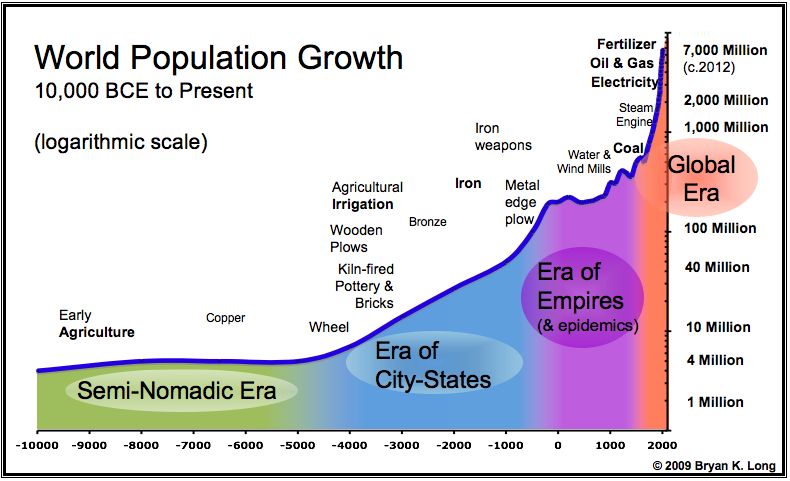
The rate of world population growth during the semi-nomadic era was very low, about 1/100 of 1%. That means for every 10,000 people alive in one year, there would be 10,001 alive the next, on average. Over the 5500 years from 10,000 BCE to 4,500 BCE, the population grew from somewhere around 4 million people to somewhere around 6 million people – we don’t know very precisely because no one was counting back then! By comparison, in 2007 there were more than 8 million people living in New York City alone.
The Era of City-States
Around 4,000 BCE, the rate of global population growth jumped to 7/100ths of 1%. Although that doesn’t sound very high, the power of a compound growth rate shows up in a more than ten-fold increase in population during the period to 500 BCE. By 500 BCE, there were approximately 100 million people on the planet, mostly concentrated in coastal southern Asia and around the Mediterranean Sea. By comparison, the population of Japan in 2009 was more than 125 million.
The Era of Empires
The expansion of political organization from city states to empires brought many economic advantages and opportunities, but it also increased war-related deaths and allowed diseases to spread more quickly. The early part of this period, from 500 BCE to around 1 CE, brought a doubling of the world population. Over the next 500 years, however, world population did not grow at all. Growth recovered around 500 CE, although the period from 500 CE to 1700 CE was marked by spurts of rapid population growth cut back by severe population declines. It was a difficult time, yet overall, the population grew six-fold through the Era of Empires with an average compound annual growth rate of 8/100ths of 1%.
Around 4,000 BCE, the rate of global population growth jumped to 7/100ths of 1%. Although that doesn’t sound very high, the power of a compound growth rate shows up in a more than ten-fold increase in population during the period to 500 BCE. By 500 BCE, there were approximately 100 million people on the planet, mostly concentrated in coastal southern Asia and around the Mediterranean Sea. By comparison, the population of Japan in 2009 was more than 125 million.
The Era of Empires
The expansion of political organization from city states to empires brought many economic advantages and opportunities, but it also increased war-related deaths and allowed diseases to spread more quickly. The early part of this period, from 500 BCE to around 1 CE, brought a doubling of the world population. Over the next 500 years, however, world population did not grow at all. Growth recovered around 500 CE, although the period from 500 CE to 1700 CE was marked by spurts of rapid population growth cut back by severe population declines. It was a difficult time, yet overall, the population grew six-fold through the Era of Empires with an average compound annual growth rate of 8/100ths of 1%.
The Global Era
Although the 300 years from 1700 to the present day has be characterized by intense national rivalries and often open warfare, advances in transportation and communications have set all nations within a global context. From around 1700, the world was round not just in scientific theory but in economic practice. Great leaps in industrial activity occurred based on the use of fossil fuels for energy. No longer was the strength of a human limited by our muscles: soon we had machines that could dig, lift, and transform raw materials into the goods and services to sustain life. With this transformation came an enormous increase in population growth. From 1700 to 2000 CE, a period of only 300 years, world population increased 10-fold to over 6,000 Million people – a compound annual growth rate of .75 %, ten times higher than in the previous era. More amazing, from 1900 to 2000, the growth rate was over 1.3 %, doubling twice in just 100 years. World population will have increased by almost as many people in the twelve years from 2000 to 2012 as it did in the 6000 years from the invention of the wheel to the invention of the steam engine!
Although the 300 years from 1700 to the present day has be characterized by intense national rivalries and often open warfare, advances in transportation and communications have set all nations within a global context. From around 1700, the world was round not just in scientific theory but in economic practice. Great leaps in industrial activity occurred based on the use of fossil fuels for energy. No longer was the strength of a human limited by our muscles: soon we had machines that could dig, lift, and transform raw materials into the goods and services to sustain life. With this transformation came an enormous increase in population growth. From 1700 to 2000 CE, a period of only 300 years, world population increased 10-fold to over 6,000 Million people – a compound annual growth rate of .75 %, ten times higher than in the previous era. More amazing, from 1900 to 2000, the growth rate was over 1.3 %, doubling twice in just 100 years. World population will have increased by almost as many people in the twelve years from 2000 to 2012 as it did in the 6000 years from the invention of the wheel to the invention of the steam engine!