
Lineamientos de la Ecología Humana
“Lineamientos de la Ecología Humana es una obra científica que ofrece un amplio y sólido conjunto de información sobre los fundamentos que dieron soporte a su elaboración.”
Gracias.

The interdisciplinary universe of Human Ecology

Deeping on Human Ecoogy
DEEPING ON HUMAN ECOLOGY
PORTUGUESE
Bases da Ecologia Humana - Ronaldo Gomes Alvim
As raízes da Ecologia Humana - Ronaldo Gomes Alvim & Juracy Marques
Da Ecologia Geral à Ecologia Humana - Francisco Carvalho
Demografia e Ecologia Humana - J. Manuel Nazareth
Ecologia Humana: um enfoque das relações homem-ambiente - Alpina Begossi
Da Ecologia Geral à Ecologia Humana - Francisco Carvalho
MULTILIGUE
Ecologia Humana uma visão global - Human Ecology a global vision - Ronaldo Gomes Alvim, Ajibola Isau Badiru & Juracy Marques
ENGLISH
Ellen Swallow Richards: mother of Human Ecology? - Robert Dyball & Liesel Carlsson
Ellen Swallow: The Woman who founded Ecology - Robert Clarke
Ellen Swallow Richards: “Humanistic Oekologist,” “Applied Sociologist,” and the founding of sociology - Barbara Richardson
What is Human Ecology? - Robert Foley
Human Ecology - Gregory Knapp
Global Social Change: Human Ecology from an Eco-Ethical Perspective - Ronaldo Gomes Alvim, Magda Matos de Oliveira & Hernán Castellanos
Food systems and human ecology: An Overview - Federico Davila & Robert Dyball
ESPAÑOL
Aspectos metodológicos de la Ecología Humana - Michel Little
VIDEOS
Ecología Humana: Historia, conceptos y dimensión en la contemporaneidad - Ronaldo Gomes Alvim
Idealizando la Ecología Humana dentro de la perspectiva académica y Científica - Ronaldo Gomes Alvim
Conciencia humana y medio ambiente sobre la mirada de la Ecología Humana - Ronaldo Gomes Alvim
Lower GDP, but Higher Quality of Life?
When GDP falls, we call it a recession, and we all know that is a bad time. Unemployment is up, the stock market is down. Earnings fall, social services falter, teachers are laid off, deficits rise. We all look anxiously at economic numbers, waiting for recovery, for GDP to rise.
But here’s the truth that we do not like to see: in a world of limited resources and many people, our fixation on increasing economic growth is luring us into disaster. Already we are using more resources than is sustainable. We can’t keep producing more each year. We have to ask instead: “What’s the difference between quantity and quality? How can we have less quantity of stuff but still have more quality of life?”
An economist could take you on an all-day tour of how to calculate Gross Domestic Product (GDP). But to put it simply, GDP attempts to quantify how much we produce in a year of goods, services and information. GDP, as most governments calculate it, misses a lot of productivity. It leaves out the services we provide to each other without the exchange of money, and doesn’t include unreported (black market) transactions. But even if it isn’t precise, repetitive measurement of GDP is supposed to give us an indication of how an economy is expanding, or falling into recession.
If we accept GDP as a measure of economic expansion, however, then it is fair to ask what fuels that expansion, what resources the expansion is consuming, and what space the economy is expanding into? Because the economy is not a virtual world where new resources can be infinitely added and energy is free. Humans are an integral part of a biological network, subsisting on energy from the sun, and living inside a thin geophysical envelope. We have only the earth and biosphere as it is, and must do our best to live enjoyably within it without degrading it.
That there are limits to growth is not a new argument. Until recently, however, those who voiced that argument were drowned out by the majority, who countered that resources are ample to our needs, and that any shortages that do arise from time to time can be overcome through new sources, or new methods. Those who suggested that GDP does not measure quality of life were put down by pointing to the historical rise in the standard of living of the industrialized nations, and by presenting the following inductive argument and rhetorical question:
a) Economic growth is historically associated with increases in living standards;
b) Increased living standards are desirable and good;
c) Therefore, economic growth is desirable and good.
“Would you deny the underdeveloped world their chance at a better life?”
Unfortunately, in this case inductive reasoning fails. The dramatic improvements in living standards over the past 300 years occurred because the human race found a new, fantastic source of energy: coal, oil and natural gas trapped in the crust of the earth. Essentially all of the technology of a modern economy is directly or indirectly based on the energy of fossil fuels. The lifestyle today of the average citizen of an advanced industrial nation is supported by an energy flow several times greater than that which supported her ancestor of 1700 – and there are many more of us alive today to be supported.
Proposing that developing economies grow their economies to provide living standards improvements presumes the underdeveloped world could grow their economies in the same way that the industrial nations have. The problem is: they can’t. The United States has about 5% of the world’s population and consumes 20-25% of global fossil fuel energy. The U.S. consumes similar percentages of other natural resources. And it has done so for many years, thus building up its industrial and social capabilities. At the same time, we have already caused atmospheric changes that will create climactic change: the world needs to begin burning less fossil fuel, not more.
Meanwhile, the population of the planet has doubled and doubled again since 1900. The argument is offered that population growth decreases when development increases, and that is hopefully true. But even with just the people we have now, there simply aren’t enough energy, mineral, or biological resources in the world to support U.S.-style economic growth for the underdeveloped countries. If development requires an increasing GDP, there is no solution to this problem.
Well then, what if we simply use energy and resources more efficiently, so that we can continue to produce more stuff, but use less matter and energy in production?
Efficiency, driven by intelligence and applied technology, is certainly key to our survival. But the question above still presumes that producing more stuff is desirable. The best way to improve efficiency, however, is to make goods that last longer rather than more goods, and services of higher quality rather than more services. The call to inventive efficiency is really a call for higher quality in our goods and services, not for a means to produce in greater quantity.
It is time to put aside, explicitly and decisively, the objective of higher GDP. GDP measures quantity, not quality of production. GDP presumes that a growth in production is a growth in quality of life, when in fact we have reached a point that the opposite is true. Not even our current level of goods production can be sustained, much less continual increases. We must instead take up new measures of efficiency and of quality of life, and manage to those, not to GDP. As soon as we completely change our mindset of growth for a mindset of quality and efficiency, we will find that there are tremendous opportunities to improve our lives and lifestyles.
For more information on GDP and alternative measures of development, see:
IEEP Patrick ten Brink’s Presentation on Beyond GDP indicators… http://tinyurl.com/5vbgv3
Beyond Growth, by Herman Daly (book) http://cli.gs/VsSYNm
Calvert – Hendersen Quality of Life Indicators (website): http://cli.gs/Bg1U16
Flynn Research, Sustainability and Quality of Life Indicators (report) http://cli.gs/nPYVgz
Chapter 5 of Herman Daly’s Steady State Economics (1977) http://cli.gs/Zjbm5Q
What is Econosystemics? Revisited.
Extracted to: BRYAN LONG
Every time someone asks me what econosystemics is, I find I tell it a little differently. I guess that’s the honest mark of an evolving paradigm; it gets a little clearer the more you think about it.
Every time someone asks me what econosystemics is, I find I tell it a little differently. I guess that’s the honest mark of an evolving paradigm; it gets a little clearer the more you think about it.
Econosystemics reframes economics to focus on the creation and accumulation of value, not only in human society, but also in this gloriously complex biosphere we are part of. We’re all in this together, and it isn’t a zero-sum game. There is hope for us all.
That is a very different approach from the economics that is taught in our universities and business schools, in which the emphasis is on the pricing and allocation and of scarce resources. Not only in the textbooks, but also in popular discourse, the focus is on a consumption-driven, human-only economy. Corporations, in this paradigm, compete to satisfy the pre-existing consumption demands of households. Households return investment and labor to the corporations, and aside from resource scarcity and waste, that’s the closed loop. Economic growth, deemed essential to a healthy economy, is about continually increasing production and consumption. Running faster and faster in the rat-race; the devil take the hindmost.
But life isn’t that neat and simple, nor so bleak.. Life on Earth is an open thermodynamic system, receiving energy from the sun and converting it, somewhat chaotically, into more life — or into things which have value for life. Life on Earth is a complex, dynamic system that keeps on evolving. Human economic activity is not fundamentally different from all the rest of life, we just take it to a different level. We channel energy from various sources through our economic infrastructure to create value: the things that we need or want. We consume much of that value, but a substantial fraction gets reinvested into our ever-evolving infrastructure. In that regard, it is a virtuous cycle of value accumulation.
We are, however, destroying value within the larger ecosystem. Humans are now a dominant force of change, responsible for environmental disruption and rapid biodiversity loss. Econosystemics, therefore, looks at our value creation in context: what value is, and how it is created and destroyed in a complex dynamic system that includes not only what we call “the economy”, but also our quality of life and all of what we call our “environment”. Econosystemics considers not just a flow of value from “nature” to human society, but examines the flows of value in all directions within the whole ecosystem web.
Econosystemics doesn’t ignore consumption, but it notices that new value creationprecedes demand. For a company like Apple, for example, the marketing mantra isn’t “Find a need and fill it,” but “Create a new need.” In econosystemics, what matters is not economic growth but economic development, which can be defined as the net accumulation of value within our entire biosphere — made thermodynamically possible by a flow of energy. If economics is the “dismal science” focused on scarcity, econosystemics is a “hopeful science” that offers the promise of human “progress” without deprivation of the many for the sake of the few, and without the destruction of our vital biosphere.
It is very important for modern corporations to internalize this viewpoint as part of their culture. The most successful corporations, in the long run, are not those that focus on building today’s products more cheaply, but those that are inventing new technologies and new ways to create and accumulate value. The most successful companies, in the long run, are not those that exploit their employees and communities, but those that invest in their employees, communities, and the environment. You see this in the trend towards corporate co-opetition, in the success of companies like Google and Apple, and in the movement towards multi-stakeholder, environmental and social responsibility.
Where this is heading is towards a responsible society of corporations, in which an informal and formal social contract emerges that enforces norms and disciplines corporations that are blatantly destroying value, whether by environmental destruction or by promoting and profiting on war and social conflicts. This isn’t just about morality; it’s about business, too. Companies that can refocus their activities away from debt-fueled, unsustainable consumption and towards an ongoing accumulation of value within the econosystem will be the most successful companies of the next decades.
Halt Environmentally Harmful Practices, Promote Sustainable Production Patterns, Secretary-General Says in International Day for Biological Diversity Message
Following is UN Secretary-General António Guterres’ message for the International Day for Biological Diversity, observed on 22 May:
From individual species through entire ecosystems, biological diversity is vital for human health and well-being. The quality of the water we drink, the food we eat and the air we breathe all depend on keeping the natural world in good health. We need healthy ecosystems to achieve the Sustainable Development Goals and to address climate change: they can provide 37 per cent of the mitigation needed to limit global temperature rise.
Yet the world’s ecosystems face unprecedented threats. An alarming and authoritative new report from the Intergovernmental Science-Policy Platform on Biodiversity and Ecosystem Services reveals that nature is declining at rates never seen before in all of human history. Since 1990, deforestation has caused the loss of more than 290 million hectares of forests that help to absorb harmful carbon dioxide emissions from the atmosphere. One million plant and animal species are at risk of extinction and more than 90 per cent of marine fish stocks are in decline or overfished.
extract to: United Nations
The impacts on people around the world will be grave. Current negative trends in biodiversity and ecosystems are projected to undermine progress towards 80 per cent of the targets for the Sustainable Development Goals. We simply cannot allow this to happen.
This year’s International Day highlights the impact of environmental neglect on food security and public health. The world’s current food system is increasingly broken. Billions of people lack access to proper nutrition. Approximately one third of what is produced is lost or wasted. The ways in which we grow, process, transport, consume and waste food are leading causes of biodiversity loss, while also contributing to climate change.
We must act quickly to reverse these trends and promote transformative change. Solutions exist. By halting environmentally harmful practices, diversifying our food systems and promoting more sustainable production and consumption patterns, we can improve global health, increase food security and strengthen resilience to climate change.
On this International Day for Biological Diversity, I urge all — Governments, businesses and civil society — to take urgent action to protect and sustainably manage the fragile and vital web of life on our one and only planet.
Urbanization: An Environmental Force to Be Reckoned With
Human beings have become an increasingly powerful environmental force over the last 10,000 years. With the advent of agriculture 8,000 years ago, we began to change the land.1 And with the industrial revolution, we began to affect our atmosphere. The recent increase in the world’s population has magnified the effects of our agricultural and economic activities. But the growth in world population has masked what may be an even more important human-environmental interaction: While the world’s population is doubling, the world’s urban population is tripling. Within the next few years, more than half the world’s population will be living in urban areas.2
The level and growth of urbanization differ considerably by region (see Figure 1). Among developing countries, Latin American countries have the highest proportion of their population living in urban areas. But East and South Asia are likely to have the fastest growth rates in the next 30 years. Almost all of future world population growth will be in towns and cities. Both the increase in and the redistribution of the earth’s population are likely to affect the natural systems of the earth and the interactions between the urban environments and populations.
Figure 1
Population Living in Urban Areas
Population Living in Urban Areas

The best data on global urbanization trends come from the United Nations Population Division and the World Bank.3 The UN, however, cautions users that the data are often imprecise because the definition of urban varies country by country. Past projections of urbanization have also often overestimated future rates of growth. Therefore, it is important to be careful in using urbanization data to draw definitive conclusions.
THE DYNAMICS OF URBANIZATION
In 1800 only about 2 percent of the world’s population lived in urban areas. That was small wonder: Until a century ago, urban areas were some of the unhealthiest places for people to live. The increased density of populations in urban areas led to the rapid spread of infectious diseases. Consequently, death rates in urban areas historically were higher than in rural areas. The only way urban areas maintained their existence until recently was by the continual in-migration of rural people.4
In only 200 years, the world’s urban population has grown from 2 percent to nearly 50 percent of all people. The most striking examples of the urbanization of the world are the megacities of 10 million or more people. In 1975 only four megacities existed; in 2000 there were 18. And by 2015 the UN estimates that there will be 22.5Much of the future growth, however, will not be in these huge agglomerations, but in the small to medium-size cities around the world.6
The growth in urban areas comes from both the increase in migration to the cities and the fertility of urban populations. Much of urban migration is driven by rural populations’ desire for the advantages that urban areas offer. Urban advantages include greater opportunities to receive education, health care, and services such as entertainment. The urban poor have less opportunity for education than the urban nonpoor, but still they have more chance than rural populations.7
Urban fertility rates, though lower than rural fertility rates in every region of the world, contribute to the growth of urban areas. Within urban areas, women who migrated from rural areas have more children than those born in urban areas.8 Of course, the rural migrants to urban areas are not a random selection of the rural population; they are more likely to have wanted fewer children even if they had stayed in the countryside. So the difference between the fertility of urban migrants and rural women probably exaggerates the impact of urban migration on fertility.
In sub-Saharan Africa, the urban fertility rates are about 1.5 children less than in rural areas; in Latin America the differences are almost two children.9 Therefore, the urbanization of the world is likely to slow population growth. It is also likely to concentrate some environmental effects geographically.
ENVIRONMENTAL EFFECTS OF URBANIZATION
Urban populations interact with their environment. Urban people change their environment through their consumption of food, energy, water, and land. And in turn, the polluted urban environment affects the health and quality of life of the urban population.
People who live in urban areas have very different consumption patterns than residents in rural areas.10 For example, urban populations consume much more food, energy, and durable goods than rural populations. In China during the 1970s, the urban populations consumed more than twice as much pork as the rural populations who were raising the pigs.11 With economic development, the difference in consumption declined as the rural populations ate better diets. But even a decade later, urban populations had 60 percent more pork in their diets than rural populations. The increasing consumption of meat is a sign of growing affluence in Beijing; in India where many urban residents are vegetarians, greater prosperity is seen in higher consumption of milk.
Urban populations not only consume more food, but they also consume more durable goods. In the early 1990s, Chinese households in urban areas were two times more likely to have a TV, eight times more likely to have a washing machine, and 25 times more likely to have a refrigerator than rural households.12 This increased consumption is a function of urban labor markets, wages, and household structure.
Energy consumption for electricity, transportation, cooking, and heating is much higher in urban areas than in rural villages. For example, urban populations have many more cars than rural populations per capita. Almost all of the cars in the world in the 1930s were in the United States. Today we have a car for every two people in the United States. If that became the norm, in 2050 there would be 5.3 billion cars in the world, all using energy.13
In China the per capita consumption of coal in towns and cities is over three times the consumption in rural areas.14 Comparisons of changes in world energy consumption per capita and GNP show that the two are positively correlated but may not change at the same rate.15 As countries move from using noncommercial forms of energy to commercial forms, the relative price of energy increases. Economies, therefore, often become more efficient as they develop because of advances in technology and changes in consumption behavior. The urbanization of the world’s populations, however, will increase aggregate energy use, despite efficiencies and new technologies. And the increased consumption of energy is likely to have deleterious environmental effects.
Urban consumption of energy helps create heat islands that can change local weather patterns and weather downwind from the heat islands. The heat island phenomenon is created because cities radiate heat back into the atmosphere at a rate 15 percent to 30 percent less than rural areas. The combination of the increased energy consumption and difference in albedo (radiation) means that cities are warmer than rural areas (0.6 to 1.3 C).16 And these heat islands become traps for atmospheric pollutants. Cloudiness and fog occur with greater frequency. Precipitation is 5 percent to 10 percent higher in cities; thunderstorms and hailstorms are much more frequent, but snow days in cities are less common.
Urbanization also affects the broader regional environments. Regions downwind from large industrial complexes also see increases in the amount of precipitation, air pollution, and the number of days with thunderstorms.17 Urban areas affect not only the weather patterns, but also the runoff patterns for water. Urban areas generally generate more rain, but they reduce the infiltration of water and lower the water tables. This means that runoff occurs more rapidly with greater peak flows. Flood volumes increase, as do floods and water pollution downstream.
Many of the effects of urban areas on the environment are not necessarily linear. Bigger urban areas do not always create more environmental problems. And small urban areas can cause large problems. Much of what determines the extent of the environmental impacts is how the urban populations behave — their consumption and living patterns — not just how large they are.
HEALTH EFFECTS OF ENVIRONMENTAL DEGRADATION
The urban environment is an important factor in determining the quality of life in urban areas and the impact of the urban area on the broader environment. Some urban environmental problems include inadequate water and sanitation, lack of rubbish disposal, and industrial pollution.18 Unfortunately, reducing the problems and ameliorating their effects on the urban population are expensive.
The health implications of these environmental problems include respiratory infections and other infectious and parasitic diseases. Capital costs for building improved environmental infrastructure — for example, investments in a cleaner public transportation system such as a subway — and for building more hospitals and clinics are higher in cities, where wages exceed those paid in rural areas. And urban land prices are much higher because of the competition for space. But not all urban areas have the same kinds of environmental conditions or health problems. Some research suggests that indicators of health problems, such as rates of infant mortality, are higher in cities that are growing rapidly than in those where growth is slower.19
URBAN ENVIRONMENTAL POLICY CHALLENGES
Since the 1950s, many cities in developed countries have met urban environmental challenges. Los Angeles has dramatically reduced air pollution. Many towns that grew up near rivers have succeeded in cleaning up the waters they befouled with industrial development. But cities at the beginning of their development generally have less wealth to devote to the mitigation of urban environmental impacts. And if the lack of resources is accompanied by inefficient government, a growing city may need many years for mitigation. Strong urban governance is critical to making progress. But it is often the resource in shortest supply.20 Overlapping jurisdictions for water, air, roads, housing, and industrial development frustrate efficient governance of these vital environmental resources. The lack of good geographic information systems means that many public servants are operating with cataracts. The lack of good statistics means that many urban indicators that would inform careful environmental decisionmaking are missing.21
When strong urban governance is lacking, public-private partnerships can become more important.22 These kinds of partnerships can help set priorities that are shared broadly, and therefore, implemented. Some of these public-private partnerships have advocated tackling the environmental threats to human health first. “Reducing soot, dust, lead, and microbial disease presents opportunities to achieve tangible progress at relatively low cost over relatively short periods,” concluded conferees at a 1994 World Bank gathering on environmentally sustainable development.23 But ultimately there are many other urban environmental priorities that produce chronic problems for both people and the environment over the long term that also have to be addressed.
Much of the research that needs to be done on the environmental impacts of urban areas has not been done because of a lack of data and funding. Most of the data that exist are at a national level. But national research is too coarse for the environmental improvement of urban areas. Therefore, data and research at the local level need to be developed to provide the local governments with the information they need to make decisions. Certainly the members of the next generation, the majority of whom will be living in urban areas, will judge us by whether we were asking the right questions today about their urban environments. They will want to know whether we funded the right research to address those questions. And they will also want to know whether we used the research findings wisely.
REFERENCES
- M. Gordon Wolman, “Population, Land Use, and Environment: A Long History,” in Population and Land Use in Developing Countries, ed. Carole L. Jolly and Barbara Boyle Torrey, Committee on Population, Commission on Behavioral and Social Sciences and Education, National Research Council (Washington, DC: National Academies Press, 1993).
- United Nations, World Urbanization Prospects: The 2003 Revision (New York: UN, 2004).
- World Bank, World Development Report 2002: Building Institutions for Markets(New York: Oxford University Press for the World Bank, 2002).
- Nathan Keyfitz, “Impact of Trends in Resources, Environment and Development on Demographic Prospects,” in Population and Resources in a Changing World, ed. Kingsley Davis et al. Stanford, CA: Morrison Institute for Population and Resource Studies, 1989).
- United Nations, World Urbanization Prospects.
- National Research Council, Cities Transformed: Demographic Change and Its Implications in the Developing World, ed. Mark R. Montgomery et al., Panel on Urban Population Dynamics, Committee on Population, Commission on Behavioral and Social Sciences and Education, National Research Council (Washington, DC: National Academies Press, 2003).
- United Nations, World Urbanization Prospects: 193.
- Martin Brockerhoff, “Fertility and Family Planning in African Cities: The Impact of Female Migration,” Journal of Biosocial Science 27, no. 3 (1995): 347-58; and Robert Gardner and Richard Blackburn, “People Who Move: New Reproductive Health Focus,” Population Reports Vol. 24, no. 3 (Baltimore, MD: Johns Hopkins School of Public Health, Population Information Program, November 1996).
- Estimates calculated from 90 Demographic and Health Surveys as reported in National Research Council, Cities Transformed: Demographic Change and Its Implications in the Developing World.
- Jyoti K. Parikh et al., Indira Gandhi Institute of Development Research, “Consumption Patterns: The Driving Force of Environmental Stress” (presented at the United Nations Conference on Environment and Development, August 1991).
- Jeffrey R. Taylor and Karen A. Hardee, Consumer Demand in China: A Statistical Factbook (Boulder, CO: Westview Press, 1986): 112.
- Taylor and Hardee, Consumer Demand in China: 148.
- U.S. Census Bureau, Statistical Abstract of the United States: 2003 (Washington, DC: Government Printing Office, 2003).
- Taylor and Hardee, Consumer Demand in China: 125.
- Gretchen Kolsrud and Barbara Boyle Torrey, “The Importance of Population Growth in Future Commercial Energy Consumption,” in Global Climate Change: Linking Energy, Environment, Economy and Equity, ed. James C. White (New York: Plenum Press, 1992): 127-42.
- Andrew S. Goudie, The Human Impact on the Natural Environment, 2d ed. (Cambridge, MA: MIT Press, 1987): 263.
- Goudie, The Human Impact on the Natural Environment: 265.
- Kolsrud and Torrey, “The Importance of Population Growth in Future Commercial Energy Consumption”: 268.
- Martin Brockerhoff and Ellen Brennan, “The Poverty of Cities in Developing Regions,” Population and Development Review 24, no. 1 (March 1998): 75-114.
- Eugene Linden, “The Exploding Cities of the Developing World,” Foreign Affairs75, no. 1 (1996): 52-65.
- Organisation of Economic Co-operation and Development (OECD), Better Understanding Our Cities, The Role of Urban Indicators (Paris: OECD, 1997).
- Ismail Serageldin, Richard Barrett, and Joan Martin-Brown, “The Business of Sustainable Cities,” Environmentally Sustainable Development Proceedings Series, no. 7 (Washington, DC: The World Bank, 1994).
- Serageldin, Barrett, and Martin-Brown, “The Business of Sustainable Cities”: 33.
What are the environmental benefits of organic agriculture?
Extract to: FAO
Sustainability over the long term. Many changes observed in the environment are long term, occurring slowly over time. Organic agriculture considers the medium- and long-term effect of agricultural interventions on the agro-ecosystem. It aims to produce food while establishing an ecological balance to prevent soil fertility or pest problems. Organic agriculture takes a proactive approach as opposed to treating problems after they emerge.
Soil. Soil building practices such as crop rotations, inter-cropping, symbiotic associations, cover crops, organic fertilizers and minimum tillage are central to organic practices. These encourage soil fauna and flora, improving soil formation and structure and creating more stable systems. In turn, nutrient and energy cycling is increased and the retentive abilities of the soil for nutrients and water are enhanced, compensating for the non-use of mineral fertilizers. Such management techniques also play an important role in soil erosion control. The length of time that the soil is exposed to erosive forces is decreased, soil biodiversity is increased, and nutrient losses are reduced, helping to maintain and enhance soil productivity. Crop export of nutrients is usually compensated by farm-derived renewable resources but it is sometimes necessary to supplement organic soils with potassium, phosphate, calcium, magnesium and trace elements from external sources.
Water. In many agriculture areas, pollution of groundwater courses with synthetic fertilizers and pesticides is a major problem. As the use of these is prohibited in organic agriculture, they are replaced by organic fertilizers (e.g. compost, animal manure, green manure) and through the use of greater biodiversity (in terms of species cultivated and permanent vegetation), enhancing soil structure and water infiltration. Well managed organic systems with better nutrient retentive abilities, greatly reduce the risk of groundwater pollution. In some areas where pollution is a real problem, conversion to organic agriculture is highly encouraged as a restorative measure (e.g. by the Governments of France and Germany).
Air and climate change. Organic agriculture reduces non-renewable energy use by decreasing agrochemical needs (these require high quantities of fossil fuel to be produced). Organic agriculture contributes to mitigating the greenhouse effect and global warming through its ability to sequester carbon in the soil. Many management practices used by organic agriculture (e.g. minimum tillage, returning crop residues to the soil, the use of cover crops and rotations, and the greater integration of nitrogen-fixing legumes), increase the return of carbon to the soil, raising productivity and favouring carbon storage. A number of studies revealed that soil organic carbon contents under organic farming are considerably higher. The more organic carbon is retained in the soil, the more the mitigation potential of agriculture against climate change is higher. However, there is much research needed in this field, yet. There is a lack of data on soil organic carbon for developing countries, with no farm system comparison data from Africa and Latin America, and only limited data on soil organic carbon stocks, which is crucial for determining carbon sequestration rates for farming practices.
Biodiversity. Organic farmers are both custodians and users of biodiversity at all levels. At the gene level, traditional and adapted seeds and breeds are preferred for their greater resistance to diseases and their resilience to climatic stress. At the species level, diverse combinations of plants and animals optimize nutrient and energy cycling for agricultural production. At the ecosystem level, the maintenance of natural areas within and around organic fields and absence of chemical inputs create suitable habitats for wildlife. The frequent use of under-utilized species (often as rotation crops to build soil fertility) reduces erosion of agro-biodiversity, creating a healthier gene pool - the basis for future adaptation. The provision of structures providing food and shelter, and the lack of pesticide use, attract new or re-colonizing species to the organic area (both permanent and migratory), including wild flora and fauna (e.g. birds) and organisms beneficial to the organic system such as pollinators and pest predators. The number of studies on organic farming and biodiversity increased significantly within the last years. A Recent Study Reporting On A Meta-Analysis Of 766 Scientific Papers concluded that organic farming produces more biodiversity than other farming systems.
Soil. Soil building practices such as crop rotations, inter-cropping, symbiotic associations, cover crops, organic fertilizers and minimum tillage are central to organic practices. These encourage soil fauna and flora, improving soil formation and structure and creating more stable systems. In turn, nutrient and energy cycling is increased and the retentive abilities of the soil for nutrients and water are enhanced, compensating for the non-use of mineral fertilizers. Such management techniques also play an important role in soil erosion control. The length of time that the soil is exposed to erosive forces is decreased, soil biodiversity is increased, and nutrient losses are reduced, helping to maintain and enhance soil productivity. Crop export of nutrients is usually compensated by farm-derived renewable resources but it is sometimes necessary to supplement organic soils with potassium, phosphate, calcium, magnesium and trace elements from external sources.
Water. In many agriculture areas, pollution of groundwater courses with synthetic fertilizers and pesticides is a major problem. As the use of these is prohibited in organic agriculture, they are replaced by organic fertilizers (e.g. compost, animal manure, green manure) and through the use of greater biodiversity (in terms of species cultivated and permanent vegetation), enhancing soil structure and water infiltration. Well managed organic systems with better nutrient retentive abilities, greatly reduce the risk of groundwater pollution. In some areas where pollution is a real problem, conversion to organic agriculture is highly encouraged as a restorative measure (e.g. by the Governments of France and Germany).
Air and climate change. Organic agriculture reduces non-renewable energy use by decreasing agrochemical needs (these require high quantities of fossil fuel to be produced). Organic agriculture contributes to mitigating the greenhouse effect and global warming through its ability to sequester carbon in the soil. Many management practices used by organic agriculture (e.g. minimum tillage, returning crop residues to the soil, the use of cover crops and rotations, and the greater integration of nitrogen-fixing legumes), increase the return of carbon to the soil, raising productivity and favouring carbon storage. A number of studies revealed that soil organic carbon contents under organic farming are considerably higher. The more organic carbon is retained in the soil, the more the mitigation potential of agriculture against climate change is higher. However, there is much research needed in this field, yet. There is a lack of data on soil organic carbon for developing countries, with no farm system comparison data from Africa and Latin America, and only limited data on soil organic carbon stocks, which is crucial for determining carbon sequestration rates for farming practices.
Biodiversity. Organic farmers are both custodians and users of biodiversity at all levels. At the gene level, traditional and adapted seeds and breeds are preferred for their greater resistance to diseases and their resilience to climatic stress. At the species level, diverse combinations of plants and animals optimize nutrient and energy cycling for agricultural production. At the ecosystem level, the maintenance of natural areas within and around organic fields and absence of chemical inputs create suitable habitats for wildlife. The frequent use of under-utilized species (often as rotation crops to build soil fertility) reduces erosion of agro-biodiversity, creating a healthier gene pool - the basis for future adaptation. The provision of structures providing food and shelter, and the lack of pesticide use, attract new or re-colonizing species to the organic area (both permanent and migratory), including wild flora and fauna (e.g. birds) and organisms beneficial to the organic system such as pollinators and pest predators. The number of studies on organic farming and biodiversity increased significantly within the last years. A Recent Study Reporting On A Meta-Analysis Of 766 Scientific Papers concluded that organic farming produces more biodiversity than other farming systems.
Genetically modified organisms. The use of GMOs within organic systems is not permitted during any stage of organic food production, processing or handling. As the potential impact of GMOs to both the environment and health is not entirely understood, organic agriculture is taking the precautionary approach and choosing to encourage natural biodiversity. The organic label therefore provides an assurance that GMOs have not been used intentionally in the production and processing of the organic products. This is something which cannot be guaranteed in conventional products as labelling the presence of GMOs in food products has not yet come into force in most countries. However, with increasing GMO use in conventional agriculture and due to the method of transmission of GMOs in the environment (e.g. through pollen), organic agriculture will not be able to ensure that organic products are completely GMO free in the future. A detailed discussion on GMOs can be found in the FAO publication "Genetically Modified Organisms, Consumers, Food Safety And The Environment".
Ecological services. The impact of organic agriculture on natural resources favours interactions within the agro-ecosystem that are vital for both agricultural production and nature conservation. Ecological services derived include soil forming and conditioning, soil stabilization, waste recycling, carbon sequestration, nutrients cycling, predation, pollination and habitats. By opting for organic products, the consumer through his/her purchasing power promotes a less polluting agricultural system. The hidden costs of agriculture to the environment in terms of natural resource degradation are reduced.
A critical review of the relationships between organic agriculture and the environment as well as other aspects is provided by IFOAM and is presented under the shape of a list of Criticisms And Frequent Misconceptions About Organic Agriculture With Corresponding Counter-Arguments.
Human Population through the Ages
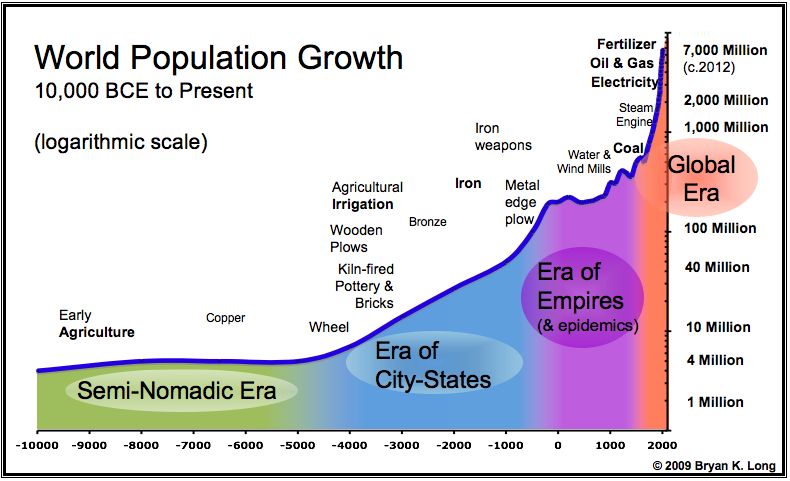
The Semi-Nomadic Era
The rate of world population growth during the semi-nomadic era was very low, about 1/100 of 1%. That means for every 10,000 people alive in one year, there would be 10,001 alive the next, on average. Over the 5500 years from 10,000 BCE to 4,500 BCE, the population grew from somewhere around 4 million people to somewhere around 6 million people – we don’t know very precisely because no one was counting back then! By comparison, in 2007 there were more than 8 million people living in New York City alone.
The Era of City-States
Around 4,000 BCE, the rate of global population growth jumped to 7/100ths of 1%. Although that doesn’t sound very high, the power of a compound growth rate shows up in a more than ten-fold increase in population during the period to 500 BCE. By 500 BCE, there were approximately 100 million people on the planet, mostly concentrated in coastal southern Asia and around the Mediterranean Sea. By comparison, the population of Japan in 2009 was more than 125 million.
The Era of Empires
The expansion of political organization from city states to empires brought many economic advantages and opportunities, but it also increased war-related deaths and allowed diseases to spread more quickly. The early part of this period, from 500 BCE to around 1 CE, brought a doubling of the world population. Over the next 500 years, however, world population did not grow at all. Growth recovered around 500 CE, although the period from 500 CE to 1700 CE was marked by spurts of rapid population growth cut back by severe population declines. It was a difficult time, yet overall, the population grew six-fold through the Era of Empires with an average compound annual growth rate of 8/100ths of 1%.
Around 4,000 BCE, the rate of global population growth jumped to 7/100ths of 1%. Although that doesn’t sound very high, the power of a compound growth rate shows up in a more than ten-fold increase in population during the period to 500 BCE. By 500 BCE, there were approximately 100 million people on the planet, mostly concentrated in coastal southern Asia and around the Mediterranean Sea. By comparison, the population of Japan in 2009 was more than 125 million.
The Era of Empires
The expansion of political organization from city states to empires brought many economic advantages and opportunities, but it also increased war-related deaths and allowed diseases to spread more quickly. The early part of this period, from 500 BCE to around 1 CE, brought a doubling of the world population. Over the next 500 years, however, world population did not grow at all. Growth recovered around 500 CE, although the period from 500 CE to 1700 CE was marked by spurts of rapid population growth cut back by severe population declines. It was a difficult time, yet overall, the population grew six-fold through the Era of Empires with an average compound annual growth rate of 8/100ths of 1%.
The Global Era
Although the 300 years from 1700 to the present day has be characterized by intense national rivalries and often open warfare, advances in transportation and communications have set all nations within a global context. From around 1700, the world was round not just in scientific theory but in economic practice. Great leaps in industrial activity occurred based on the use of fossil fuels for energy. No longer was the strength of a human limited by our muscles: soon we had machines that could dig, lift, and transform raw materials into the goods and services to sustain life. With this transformation came an enormous increase in population growth. From 1700 to 2000 CE, a period of only 300 years, world population increased 10-fold to over 6,000 Million people – a compound annual growth rate of .75 %, ten times higher than in the previous era. More amazing, from 1900 to 2000, the growth rate was over 1.3 %, doubling twice in just 100 years. World population will have increased by almost as many people in the twelve years from 2000 to 2012 as it did in the 6000 years from the invention of the wheel to the invention of the steam engine!
Although the 300 years from 1700 to the present day has be characterized by intense national rivalries and often open warfare, advances in transportation and communications have set all nations within a global context. From around 1700, the world was round not just in scientific theory but in economic practice. Great leaps in industrial activity occurred based on the use of fossil fuels for energy. No longer was the strength of a human limited by our muscles: soon we had machines that could dig, lift, and transform raw materials into the goods and services to sustain life. With this transformation came an enormous increase in population growth. From 1700 to 2000 CE, a period of only 300 years, world population increased 10-fold to over 6,000 Million people – a compound annual growth rate of .75 %, ten times higher than in the previous era. More amazing, from 1900 to 2000, the growth rate was over 1.3 %, doubling twice in just 100 years. World population will have increased by almost as many people in the twelve years from 2000 to 2012 as it did in the 6000 years from the invention of the wheel to the invention of the steam engine!
Os 'favores' vitais da natureza ao homem
postado em 26/04/2019 11:31
O declínio acelerado da biodiversidade ameaça os múltiplos benefícios vitais que a natureza fornece ao homem, como os medicamentos, a polinização de cultivos e a regulação do clima, segundo os especialistas.
"Normalmente as pessoas não vinculam a natureza com a segurança alimentar, a água potável, a coesão social...", lamenta Bob Watson, presidente da plataforma científica para a biodiversidade IPBES.
"Mas a perda de biodiversidade tem implicações econômicas e sociais". "E não são só os grandes animais carismáticos os que contam, mas também o besouro, os vermes, o morcego, são a pedra angular dos ecossistemas".
- Alimentos -
O primeiro "favor" que os insetos nos fazem é polinizar os cultivos. Cerca de 1,4 bilhão de empregos e 3/4 dos cultivos dependem disso, segundo um estudo.
"Hoje em dia, nos Estados Unidos, as pessoas transportam milhões de abelhas de um pomar a outro para polinizar", segundo Watson. "Mas sabemos que a diversidade importa tanto quanto o número: uma mistura de abelhas selvagens e domésticas será mais eficaz que só domésticas".
A redução de insetos provoca ao mesmo tempo a dos predadores: pássaros, ouriços, lagartos, anfíbios... que protegem os cultivos eliminando as lagartas. Em menos de 30 anos, a queda do número de insetos na Europa (-80%) contribuiu para o desaparecimento de mais de 400 milhões de pássaros.
As rãs e outros anfíbios são os que estão mais ameaçados, segundo o biólogo Gilles Boeuf, que lembra que na história da Terra eles "foram os primeiros a sair da água e respirar, e vamos perder isto!".
Outro entorno em perigo são os recifes de coral que protegem as costas da erosão, alimentam os peixes e abrigam 30% das espécies marinhas. Mais de 500 milhões de pessoas dependem diretamente deles.
- Saúde -
Metade dos nossos medicamentos procedem de espécies vivas, sobretudo vegetais, e de animais, especialmente marinhos.
Como exemplo, a estrela-do-mar e o ouriço-do-mar contribuíram com o desenvolvimento de quimioterapias contra o câncer.
Perante a poluição, a vegetação filtra os agentes poluentes. Em Xangai, os parques permitem capturar 10% das partículas finas, segundo um estudo. Uma árvore pode absorver até 20 kg/ano destas partículas, segundo outro informe de 2008.
Muitas investigações mostraram os vínculos entre a natureza e a saúde (alergias, doenças crônicas, psicológicas...)
Nos Estados Unidos, um estudo que acompanhou 100.000 mulheres que viviam em ambientes urbanos durante oito anos revelou que as que viviam a menos de 250 metros de um espaço verde tinham uma taxa de mortalidade 12% inferior ao resto, especialmente em relação a casos de câncer.
A Escola Médica de Harvard detalhou os benefícios da natureza na cidade: menos poluição, ruído, estresse...
- Água -
Plantas e micro-organismos contribuem para sanear as camadas da terra.
Nas cidades, o Conselho Econômico e Social francês destacou recentemente um regresso às "soluções verdes alternativas à gestão das águas pluviais só com tubulações". Esta opção serve igualmente para limitar as inundações.
"Nenhuma estação de tratamento vale o mesmo que um pântano bem vivo", confirma Gilles Boeuf.
"Os elementos vivos são indispensáveis para o homem: um corpo humano tem tantas bactérias quanto células humanas e um recém-nascido é 3/4 composto de água", afirma.
- Em cifras? -
Alguns especialistas defendem quantificar estes "favores" gratuitos da biodiversidade, para dar mais visibilidade a eles. Os economistas os calcularam em 125 bilhões de dólares por ano, ou seja, 1,5 vez o PIB mundial.
Por exemplo, o valor da polinização se aproxima de 200 bilhões de euros anuais.
Segundo o estudo sobre a Economia dos Ecossistemas (TEEB), publicado em 2010, a erosão da biodiversidade custa entre 1,3 e 3,1 trilhões de euros por ano.
Este conceito de "capital natural" continua sem ser compreendido, reconheceu recentemente o economista Pavan Sukhdev, que dirigiu este estudo e preside atualmente a área internacional da WWF.
"Trata-se de encontrar uma razão racional para garantir que esta riqueza pública se conserve. Líderes empresariais e dirigentes econômicos têm o devem mundial de reconhecer estas externalidades".
Assinar:
Postagens (Atom)